

🦶 Heel CrackCauses, Remedies, and Prevention for Men, Women, and Elders
Updated: Mar 19

🌿 Start:
👣 Your feet are what make it possible for you to move around, but they are often the most neglected part of your body. Heel fissures, or cracked heels, can hurt, look bad, and in some cases, be dangerous. Due to differences in lifestyle, footwear, and skin conditions, they affect men, women, and older people in different ways
🌸 This guide will help you learn how to heal cracked heels naturally and keep them from coming back, whether you walk a lot, wear open sandals, or are just getting older and your skin is getting drier.
What Makes Heels Crack?
💧 When the skin around your heels gets dry, thick, and loses its elasticity, it can cause heel cracks. This dry skin splits when you walk, which hurts.
🩺 Some common causes are:

🌬️ Dry skin from being dehydrated or being in bad weather
🧍 Standing on hard floors for a long time
👣 Walking around without shoes or in shoes with open backs
⚖️ Being overweight puts more stress on the heels
🚫 Not taking care of your feet or not moisturising them often
🩸 Health problems like diabetes, eczema, or hypothyroidism
⏳ Ageing makes skin thinner and less stretchy
3. Reasons that are Specific to Gender and Age
👨 For Men
🦶 Men often don't take care of their feet on a regular basis
💨 Dust, sweat, and rough shoes that are always on your feet dry out your heels
🌤️ Standing or working outside makes the condition worse.
👩 For Women
👡 Women are more likely to get cracked heels because they wear open sandals, heels, or get pedicures that strip away natural oils
💧 Changes in hormones can also make the skin less hydrated.
👵 For Older People
⏳ As people get older, they produce less oil and sweat, which makes their heels dry and rough, making them easy to crack
❤️🩹 Older people with diabetes or poor blood circulation are especially at risk.
4. Signs and Symptoms

🩺 Recognising the early signs of heel cracking can help it heal faster:
🧱 Skin that is rough, flaky, or peeling around the heels
🎨 Dry spots that are yellow, brown, or white
💢 Deep cracks that could hurt or bleed
🔥 Itching, burning, or pain when you walk
🦶 Calluses that have hardened or skin that has built up too much
⚠️ If not treated, the cracks could get worse, which could lead to infections from bacteria or fungi.
Home Remedies That Work for Heel Cracks

Here are some natural treatments that have been shown to work that you can do at home to fix cracked heels and make them smooth again:
🥥 a. Coconut Oil and Honey
🍯 Honey is a natural humectant and antibacterial agent, and coconut oil keeps skin moist
How to Use:
Combine the coconut oil and honey in equal parts
Before bed, rub it into your heels
Put on socks before bed.
🧈 b. Shea Butter or Ghee
Both are good sources of vitamins A and E, which are important for healing skin.
How to Use:
Heat up a little and put it on the cracks
Leave it out overnight.
🍋 c. Lemon and Glycerin Soak
Lemon gets rid of dead skin, and glycerin makes skin softer and more hydrated.
How to Use:
Put lemon juice and 2 tablespoons of glycerin in warm water
Soak your feet for 15 to 20 minutes, scrub them lightly, and then pat them dry.
🧂 d. Bath for the Feet with Epsom Salt
Great for exfoliating and relaxing.
How to Use:
Put half a cup of Epsom salt in warm water
Soak for 10 to 15 minutes, then put on moisturiser.
🧴 e. The Petroleum Jelly and Socks Method
A classic way to keep moisture in overnight.
How to Use:
Put petroleum jelly on your heels before bed
Put on cotton socks before bed.
Natural Oils That Help Heal Cracked Heels
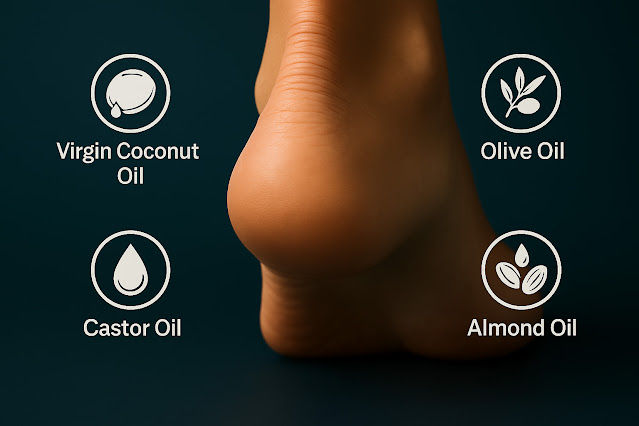
🌿 Some of the best moisturisers for foot health come from nature
🌿 Oil Type | 💧 Benefits | 🕒 Application |
🥥 Virgin Coconut Oil | ✨ Antibacterial & antifungal | 🚿 Apply daily after a bath |
🌰 Castor Oil | 💦 Softens thick, hard skin | 🌙 Massage deeply at night |
🫒 Olive Oil | 🌼 Improves elasticity and hydration | 🛏️ Apply before bed |
🌿 Tea Tree Oil | 🩹 Prevents infection in open cracks | 💧 Mix a few drops with coconut oil |
🌸 Almond Oil | 🌟 Enhances softness and glow | 🌞🌙 Apply morning and night |
🛑 It's Easier to Stop Heel Cracks Than to Fix Them:
✨ Do the following simple things:
🗓️ Every Day
🚿 Use lukewarm water and mild soap to wash your feet
🧻 Pat dry; don't rub too hard
🧴 As soon as you dry off, put on a moisturiser or natural oil.
📅 Routine for the Week
🦶 Put salt or lemon in warm water and soak your feet
🪶 Use a pumice stone or soft brush to scrub gently
✂️ Cut your toenails and clean the space between them.
👟 Advice on Shoes
🚫 Don't wear shoes with open backs or hard soles
👣 Use soft heel pads or shoes that absorb shock
🌬️ To keep fungus from growing, always keep your shoes clean and dry.
🥗 Food and Water for Healthy Feet
Cracked heels are a common sign of not getting enough water or nutrients.To keep skin healthy and flexible:
💧 Watering
To keep your skin moist, drink 2 to 3 litres of water every day
🍎 Foods That Are High in Nutrients
Add these things to your diet:
🥜 Almonds, sunflower seeds, & spinach are all good sources of vitamin E
🐟 Flaxseed, salmon, & walnuts are all good sources of omega-3 fatty acids
🌰 Lentils, chickpeas, and pumpkin seeds are all good sources of zinc
🍋 Bone broth, eggs, and citrus fruits are all good for collagen.
🩺 When to Go to the Doctor
If you have any of the following, talk to a doctor:
💉 Cracks are bleeding, hurt, or infected
⚠️ You see swelling or pus forming
🩸 You have either diabetes or neuropathy
⏱️ After 2 to 3 weeks of care, heel cracks don't get better.
A foot doctor may give you medicated foot creams, antibiotics, or custom orthotic heel pads.
🧴 Make Your Own Foot Cream for Cracked Heels
Here's a recipe for making your own heel cream from scratch:
🌸 Things You Need
🥥 2 tablespoons of coconut oil
🧈 1 tablespoon of shea butter
🕯️ 1 tsp of beeswax
💜 3 drops of lavender essential oil
🪄How to Do It
♨️ In a double boiler, melt all the ingredients
🌀 Mix together and pour into a small container
❄️ Let it cool down and harden
🧦 Put it on every night before putting on socks.
🌸 This mix heals skin damage, calms inflammation, and makes skin smooth again naturally.
💬 A Quote to Get You Going
🌿 "Take care of your feet; they take you to your dreams."🌸 "From the ground up, healing starts."
Scientific Backup
1. Title: A randomized double-blind controlled trial comparing extra virgin coconut oil with mineral oil as a moisturizer for mild to moderate xerosis (Agero ALC, Verallo-Rowell VM)
Journal: Dermatitis, 2004
Result: This RCT in 34 subjects found that virgin coconut oil was as effective and safe as mineral oil in improving skin hydration and lipid levels in xerosis. This supports natural oil use in dry cracked skin (including heels).
DOI: 10.2310/6620.2004.04006
2. Title: Management of Padadari (cracked feet) with Rakta Snuhi (Euphorbia caducifolia Haines) based formulation: An open-labeled clinical study (Gupta S., Acharya R.)
Journal: AYU (An International Quarterly Journal of Research in Ayurveda), 2018
Result: In 26 patients with cracked heels (Padadari), twice-daily application of the formulation for 21 days resulted in statistically highly significant improvements in cracks with pain (p<0.001), dryness (rukshata p<0.001) and itching (kandu p<0.001)
DOI: 10.4103/ayu.AYU_57_183.
3.Title: Natural Oils for Skin-Barrier Repair: Ancient Compounds Now Backed by Modern
Journal: American Journal of Clinical Dermatology, 2018.
Result: Narrative review summarizing evidence for plant oils (coconut, sunflower, jojoba, argan, etc.) showing many oils can help barrier repair, reduce inflammation and support healing — but effects depend on oil composition (linoleic vs oleic acid).
DOI: 10.1007/s40257-017-0301-1
4. Title: Effects of Extra Virgin Olive Oil and Petrolatum on Skin Barrier Function and Microtopography
Journal:Journal of Clinical Medicine, 2025
Result:Controlled study showing both extra-virgin olive oil and petrolatum improved some measures of skin hydration and reduced desquamation; petrolatum reduced TEWL more — evidence that certain oils can benefit skin barrier metrics (use with attention to oil type and skin).
DOI:10.3390/jcm14134675
📜 Notice
⚠️ This article is only for educational purposes and should not be used instead of professional medical advice.👩⚕️ If your heel cracks are deep, hurt, or bleeding, or if they are infected, you should see a doctor or dermatologist right away.📅 Depending on how bad the condition is and how well you follow the recommended care routines, the results may be different for each person.
🌼 Final Thoughts

✨Lot of people have cracked heels, but they don't have to stay that way.
You can make your heels soft and strong again by drinking plenty of water, using natural oils and taking care of your feet.
No matter if you're a busy man, a fashionable woman, or a wise elder, every step you take to take care of yourself makes you feel better and more confident.
👣 "Walk softly and care deeply; your feet are the first step to health and happiness." 💫
🙌 12. Call to Action (CTA)
🦶 Your feet need as much care as your hands and face do. Begin taking care of your heels right away! Keep a jar of natural moisturiser next to your bed. Drink plenty of water every day. And do these simple foot rituals.
👉 Keep in mind that healthy heels are not only about looks; they also show how healthy you are overall.
❓ 13. Questions That Are Often Asked (FAQs)
1️⃣ How can I heal my cracked heels the fastest?
💧 For quick results, put on a thick moisturiser like shea butter or petroleum jelly, wear socks overnight, and do it every day.
2️⃣ Is it okay to put Vaseline on cracked heels?
🧴 Yes, using Vaseline (petroleum jelly) on a regular basis keeps moisture in and softens rough skin.
3️⃣ Do cracked heels mean you have a health problem?
⚕️ Sometimes. Diabetes, thyroid problems, and eczema are some of the conditions that can make the skin more likely to dry out and crack.
4️⃣ What can older people do to keep their heels from cracking?
👵 By using gentle cleansers, putting on thick moisturisers, wearing shoes with cushioning, and staying hydrated.
5️⃣ Do I need to exfoliate every day?
🪶 No. Use a pumice stone or mild scrub to exfoliate once or twice a week to keep the skin from getting too thin.
6️⃣ Do men need their own heel creams?
👨 Not always. Men with thicker or rougher heels can, on the other hand, use creams with urea or lactic acid to get more moisture.
7️⃣ Is it possible for cracked heels to get infected?🦠
Yes, deep cracks can hold bacteria and fungi, which can cause redness, swelling, and pus if not treated.
8️⃣ Is it bad for your heels to walk barefoot?
🚫 Yes. It causes friction, takes away natural oils, and exposes feet to dust, which makes them dry and crack.
9️⃣ Which home remedy works best overnight?🌙
Putting on socks with a mix of coconut oil and honey or petroleum jelly is a great way to heal overnight.
🔟 How long does it take for cracked heels to heal on their own?
⏳ Most mild heel cracks heal in 7 to 10 days with regular care, but deeper cracks may take 3 to 4 weeks.
📚References – Cracked Heels & Skin Barrier Health
🧴 Skin Barrier Function & Xerosis (Dry Skin)
Elias, P. M. (2005). Stratum corneum defensive functions. Journal of Investigative Dermatology, 125(2), 183–200. https://doi.org/10.1111/j.0022-202X.2005.23668.x
Proksch, E., Brandner, J. M., & Jensen, J. M. (2008). Skin barrier function. Experimental Dermatology, 17(12), 1063–1072. https://doi.org/10.1111/j.1600-0625.2008.00786.x
Rawlings, A. V., & Harding, C. R. (2004). Moisturization and barrier function. Dermatologic Therapy, 17(Suppl 1), 43–48. https://doi.org/10.1111/j.1396-0296.2004.04S1005.x
💧 Moisturizers & Natural Oils
Agero, A. L. C., & Verallo-Rowell, V. M. (2004). Coconut oil vs mineral oil in xerosis. Dermatitis, 15(3), 109–116. https://doi.org/10.2310/6620.2004.04006
Lin, T. K., Zhong, L., & Santiago, J. L. (2018). Plant oils in skin barrier repair. International Journal of Molecular Sciences, 19(1), 70. https://doi.org/10.3390/ijms19010070
Danby, S. G., et al. (2011). Effect of emollients on skin barrier. British Journal of Dermatology, 165(2), 329–336. https://doi.org/10.1111/j.1365-2133.2011.10305.x
🧪 Petroleum Jelly & Occlusive Therapy
Lodén, M. (2003). Role of emollients and moisturizers. American Journal of Clinical Dermatology, 4(11), 771–788. https://doi.org/10.2165/00128071-200304110-00005
Voegeli, R. (2013). Moisturizers and skin hydration mechanisms. Skin Pharmacology and Physiology, 26(3), 113–119. https://doi.org/10.1159/000346591
🦶 Foot Care, Calluses & Heel Fissures
Karthikeyan, K. (2015). Cracked heels: Causes and management. Indian Dermatology Online Journal, 6(3), 163–168. https://doi.org/10.4103/2229-5178.156386
Burrows, S., et al. (2017). Heel fissures and foot skin disorders. Journal of Foot and Ankle Research, 10, 24. https://doi.org/10.1186/s13047-017-0205-5
🩺 Diabetes, Aging & Skin Health
Boulton, A. J. M. (2004). Diabetic foot complications. Lancet, 366(9498), 1719–1724. https://doi.org/10.1016/S0140-6736(05)67604-5
Luebberding, S., et al. (2013). Age-related skin changes. Skin Research and Technology, 19(1), e220–e225. https://doi.org/10.1111/srt.12040
🧂 Exfoliation & Keratin Management
Draelos, Z. D. (2012). Role of exfoliation in skin care. Dermatologic Clinics, 30(1), 37–45. https://doi.org/10.1016/j.det.2011.08.003
Lodén, M., et al. (2004). Urea-based moisturizers and skin hydration. Acta Dermato-Venereologica, 84(1), 45–49. https://doi.org/10.1080/00015550310005513
🦠 Infection Risk & Skin Integrity
Dryden, M. S. (2010). Skin hygiene and infection prevention. International Journal of Antimicrobial Agents, 36(Suppl 1), S2–S7. https://doi.org/10.1016/j.ijantimicag.2010.11.005
Williams, H. C., et al. (2008). Skin barrier dysfunction and infection. British Journal of Dermatology, 158(1), 3–10. https://doi.org/10.1111/j.1365-2133.2007.08335.x
🥗 Nutrition, Hydration & Skin Health
Boelsma, E., et al. (2001). Nutritional skin care. American Journal of Clinical Nutrition, 73(5), 853–864. https://doi.org/10.1093/ajcn/73.5.853
Palma, L., et al. (2015). Hydration and skin physiology. Clinical, Cosmetic and Investigational Dermatology, 8, 413–421. https://doi.org/10.2147/CCID.S88440
🌿 Traditional & Herbal Treatments
Gupta, S., & Acharya, R. (2018). Ayurvedic treatment of cracked heels (Padadari). AYU, 39(2), 83–87. https://doi.org/10.4103/ayu.AYU_57_18
Prottey, C., et al. (1975). Role of emollients in dry skin treatment. British Journal of Dermatology, 92(4), 373–380. https://doi.org/10.1111/j.1365-2133.1975.tb03091.x


Comments