

🌐 Strength Training for Longevity: The Science-Backed Blueprint for Men, Women, and Elders to Live Longer, Stronger, and Healthier Lives
Updated: Apr 17

🧭 Introduction: From Lifespan to Health span
Human life expectancy has increased dramatically over the past century—but quality of life has not kept pace. Many people now live longer, yet spend their later years battling chronic disease, frailty, and dependence.
This is where strength training becomes transformative.
Unlike many interventions, resistance training directly targets the root causes of aging:
Muscle loss (sarcopenia)
Metabolic decline
Hormonal imbalance
Bone deterioration
Neurological degeneration
👉 Strength training is not just exercise—it is preventive medicine.
🧬 The Biology of Aging and Muscle Loss

🔍 What Happens as We Age?
Starting around age 30:
Muscle mass declines by 3–8% per decade
Strength declines faster than muscle
Fat mass increases
Bone density decreases
This process is called sarcopenia, and it is one of the strongest predictors of:
Frailty
Falls
Disability
Mortality
⚠️ Why Muscle Loss Is Dangerous
Muscle is not just for movement—it is essential for survival:
Regulates blood sugar
Stores amino acids
Produces anti-inflammatory molecules
Supports immune function
👉 Losing muscle = losing metabolic control
🔬 Strength Training as Anti-Aging Medicine

1. Cellular-Level Benefits
Strength training impacts:
Mitochondria → improves energy production
Telomeres → slows cellular aging
Protein synthesis → repairs tissue
2. Myokines: The Longevity Molecules
Muscles release myokines, which:
Reduce inflammation
Improve brain function
Protect against chronic disease
This is why muscle is now called an endocrine organ.
3. Hormonal Optimization
Strength training enhances:
Testosterone
Growth hormone
IGF-1
These hormones decline with age—but training can partially restore them.
📊 Strength vs Cardio: Which Is Better for Longevity?

🏃 Cardio Benefits
Heart health
Endurance
Calorie burning
🏋️ Strength Training Benefits
Muscle preservation
Metabolic health
Bone strength
Functional independence
🏆 The Verdict
👉 The best longevity results come from combining both
However, strength training uniquely prevents frailty, making it essential.
👨 Strength Training for Men

🔥 Key Longevity Benefits
Maintains testosterone
Reduces abdominal fat
Prevents metabolic syndrome
Enhances cardiovascular resilience
📉 Testosterone Decline
Men lose ~1% testosterone per year after 30.
Strength training:
Boosts natural production
Improves hormonal balance
Enhances vitality
🧠 Mental Strength
Resistance training improves:
Confidence
Stress tolerance
Cognitive clarity
🏋️ Practical Routine for Men
Beginner (3 days/week):
Squats – 3×10
Push-ups – 3×10
Rows – 3×10
Plank – 30 sec
👩 Strength Training for Women

💪 Unique Advantages
Prevents osteoporosis
Improves body composition
Enhances insulin sensitivity
Supports hormonal balance
🦴 Bone Health
Women are at higher risk of bone loss after menopause.
Strength training:
Increases bone mineral density
Reduces fracture risk
🔄 Hormonal Benefits
Improves estrogen balance
Reduces symptoms of menopause
Supports thyroid health
🏋️ Practical Routine for Women
Beginner:
Lunges – 3×10
Dumbbell press – 3×10
Glute bridge – 3×12
Core exercises
👴 Strength Training for Elders

⚠️ The Reality of Aging
After 60:
Muscle loss accelerates
Fall risk increases
Independence declines
🧠 Why Strength Training Is Critical
It improves:
Balance
Coordination
Reaction time
🛡️ Fall Prevention
Falls are a leading cause of death in elders.
Strength training reduces fall risk by:
Improving muscle strength
Enhancing stability
🏋️ Safe Routine for Seniors
Chair squats
Wall push-ups
Resistance bands
Walking + light weights
🏗️ The Complete Longevity Training Blueprint
🔁 Weekly Structure
Option A (Beginner)
2 strength sessions
2 walking/cardio sessions
Option B (Intermediate)
3 strength sessions
2 cardio sessions
🎯 Training Principles
1. Progressive Overload
Gradually increase intensity
2. Consistency
More important than intensity
3. Recovery
Essential for growth
🥗 Nutrition for Strength and Longevity

🍗 Protein: The Foundation
1.2–2.0 g/kg body weight
🧪 Micronutrients
Vitamin D → bone health
Omega-3 → inflammation
Magnesium → muscle function
💧 Hydration
Critical for:
Performance
Recovery
🥗 Nutrition for Strength Training and Longevity (All Ages & Diet Types)
🧬 1. Protein Needs (Core for Everyone)
Group | Daily Protein |
Men | 1.6–2.0 g/kg |
Women | 1.2–1.6 g/kg |
Elders | 1.2–1.5 g/kg |
👉 Elders need slightly higher quality protein due to reduced absorption.
🍗 2. Non-Vegetarian Protein Sources

Eggs
Chicken
Fish
Lean meat
Dairy
👉 Benefits:
Complete amino acids
Faster muscle recovery
Higher protein density
🌱 3. Vegetarian Protein Sources

Lentils (dal)
Chickpeas
Beans
Paneer
Tofu
Nuts & seeds
👉 Important Tip:Combine foods (e.g., rice + dal) for complete protein
⚖️ 4. Key Differences: Veg vs Non-Veg
Factor | Vegetarian | Non-Vegetarian |
Protein Quality | Moderate | High |
Digestion | Slower | Faster |
Nutrients | Needs planning | More direct |
Muscle Gain | Possible (needs effort) | Easier |
👉 Both work—but vegetarian diets need better planning
👨 Nutrition for Men
Focus
Muscle mass
Testosterone
Energy
Best Foods
Eggs / paneer
Fish / lentils
Nuts
Whole grains
👩 Nutrition for Women
Focus
Bone health
Hormonal balance
Iron levels
Best Foods
Calcium-rich foods (milk, ragi)
Iron-rich foods (spinach, legumes)
Protein (paneer, eggs, tofu)
👴 Nutrition for Elders
Focus
Easy digestion
Muscle preservation
Bone strength
Best Foods
Soft proteins (curd, dal, eggs)
Soups
Steamed vegetables
👉 Smaller, frequent meals work best
📅 Sample Daily Meal Plan (Veg & Non-Veg)
🌱 Vegetarian Plan
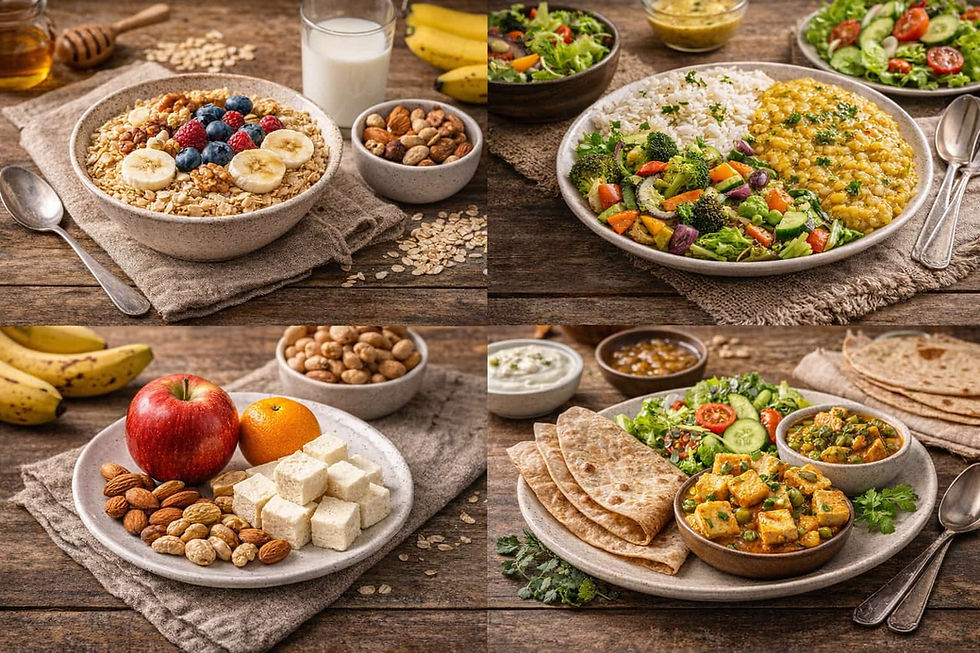
🥣 Breakfast: Oats + mixed nuts + milk (add berries or banana)
🍛 Lunch: Rice + dal (lentils) + sautéed vegetables + salad
🍎 Snack: Fresh fruit (apple/orange) + peanuts or almonds
🍽️ Dinner: Whole wheat roti + paneer or tofu + light vegetable curry
🍗 Non-Vegetarian Plan

🍳 Breakfast: Boiled/scrambled eggs + whole grain toast + fruit
🍗 Lunch: Rice or quinoa + grilled chicken/fish + vegetables + salad
🥣 Snack: Yogurt (curd/Greek yogurt) + nuts/seeds
🍽️ Dinner: Light protein (grilled chicken/fish or egg whites) + steamed vegetables
⚠️ Important Tips (All Groups)
Stay hydrated
Avoid ultra-processed foods
Balance protein across meals
Combine strength training + nutrition
🧠 Brain and Cognitive Benefits
Strength training improves:
Memory
Learning
Neuroplasticity
It reduces risk of:
Alzheimer’s
Dementia
😌 Mental Health Benefits
Reduces anxiety
Improves mood
Builds resilience
❌ Common Mistakes
Skipping strength training
Poor technique
Overtraining
Ignoring recovery
Low protein intake
📈 Advanced Longevity Strategies

1. Power Training
Explosive movements improve survival
2. Grip Strength Training
Strong predictor of lifespan
3. Functional Training
Improves daily life activities
🔮 The Future of Longevity Fitness
Personalized exercise medicine
AI-based training plans
Biomarker-driven fitness
🏁 Conclusion
Strength Is the Foundation of a Longer, Better Life

Longevity is no longer a mystery—it is a choice shaped by daily actions.
Science has made one thing undeniably clear:
👉 Strength training is one of the most powerful, accessible, and proven tools to extend both lifespan and healthspan.
It is not about lifting heavy weights or becoming a bodybuilder. It is about building a body that can:
Move freely without pain
Resist disease and metabolic decline
Maintain independence with age
Support a sharp, resilient mind
From your 20s to your 70s and beyond, strength training acts as a biological shield against aging. It slows muscle loss, strengthens bones, enhances brain function, and improves hormonal balance.
For men, it preserves vitality, muscle mass, and metabolic health. For women, it protects bone density, supports hormonal balance, and enhances body composition. For elders, it restores independence, reduces fall risk, and improves quality of life.
The most important insight is this:
👉 You don’t need perfection—you need consistency.
Even two sessions per week can:
Reduce your risk of chronic disease
Improve your physical and mental strength
Add years to your life—and life to your years
In a world filled with complex health advice, strength training stands out because it is simple, effective, and backed by decades of scientific research.
🚀 Call to Action: Your Stronger, Longer Life Starts Today
You’ve explored the science. You understand the strategy.
👉 Now it’s time to take action.
Because strength is not built by reading—it’s built by doing.
🔥 Start Your Strength Journey in 3 Simple Steps
✅ Commit to 2–3 strength sessions per week
✅ Focus on basic, effective movements (squats, push-ups, rows)
✅ Fuel your body with balanced nutrition (veg or non-veg)
👉 Stay consistent for just 30 days—you will feel the difference.
💡 Imagine Your Future
Walking with strength and confidence
Living independently at any age
Free from preventable lifestyle diseases
Mentally sharp and physically capable
👉 This is not luck—it is the result of daily habits.
📚 References
Shailendra, P., Baldock, K. L., Li, L. S. K., Bennie, J. A., & Biddle, S. J. H. (2022). Resistance training and mortality risk: A systematic review and meta-analysis. American Journal of Preventive Medicine, 63(2), 277–285. https://doi.org/10.1016/j.amepre.2022.03.020
Momma, H., Kawakami, R., Honda, T., Sawada, S. S., & Blair, S. N. (2022). Muscle-strengthening activities and mortality risk: A systematic review and meta-analysis. British Journal of Sports Medicine, 56(13), 755–763. https://doi.org/10.1136/bjsports-2021-104719
Peterson, M. D., Sen, A., & Gordon, P. M. (2012). Influence of resistance exercise on lean body mass in aging adults. Ageing Research Reviews, 11(3), 226–237. https://doi.org/10.1016/j.arr.2012.02.002
Ruiz, J. R., Sui, X., Lobelo, F., et al. (2008). Association between muscular strength and mortality in men. BMJ, 337, a439. https://doi.org/10.1136/bmj.a439
Schoenfeld, B. J. (2010). The mechanisms of muscle hypertrophy. Journal of Strength and Conditioning Research, 24(10), 2857–2872. https://doi.org/10.1519/JSC.0b013e3181e840f3
Phillips, S. M. (2014). A brief review of protein requirements in aging. Applied Physiology, Nutrition, and Metabolism, 39(11), 1247–1252. https://doi.org/10.1139/apnm-2013-0500
Phillips, S. M. (2014). A brief review of protein requirements in aging. Applied Physiology, Nutrition, and Metabolism, 39(11), 1247–1252. https://doi.org/10.1139/apnm-2013-0500
Morton, R. W., Murphy, K. T., McKellar, S. R., et al. (2018). Protein supplementation and resistance training. British Journal of Sports Medicine, 52(6), 376–384. https://doi.org/10.1136/bjsports-2017-097608
Kraemer, W. J., & Ratamess, N. A. (2005). Hormonal responses and adaptations. Sports Medicine, 35(4), 339–361. https://doi.org/10.2165/00007256-200535040-00004
Pedersen, B. K., & Febbraio, M. A. (2008). Muscle as an endocrine organ. Physiological Reviews, 88(4), 1379–1406. https://doi.org/10.1152/physrev.90100.2007
Liu-Ambrose, T., Nagamatsu, L. S., Graf, P., et al. (2010). Resistance training and cognitive function. Archives of Internal Medicine, 170(2), 170–178. https://doi.org/10.1001/archinternmed.2009.494
Cruz-Jentoft, A. J., Baeyens, J. P., Bauer, J. M., et al. (2010). Sarcopenia: European consensus. Age and Ageing, 39(4), 412–423. https://doi.org/10.1093/ageing/afq034
Fiatarone, M. A., Marks, E. C., Ryan, N. D., et al. (1990). High-intensity strength training in elderly. JAMA, 263(22), 3029–3034. https://doi.org/10.1001/jama.1990.03440100053029
Villareal, D. T., Chode, S., Parimi, N., et al. (2011). Weight loss, exercise, and frailty in older adults. New England Journal of Medicine, 364(13), 1218–1229. https://doi.org/10.1056/NEJMoa1008234
Fielding, R. A., Vellas, B., Evans, W. J., et al. (2011). Sarcopenia: Clinical implications. Journal of the American Medical Directors Association, 12(4), 249–256. https://doi.org/10.1016/j.jamda.2011.01.003
Garber, C. E., Blissmer, B., Deschenes, M. R., et al. (2011). Quantity and quality of exercise. Medicine & Science in Sports & Exercise, 43(7), 1334–1359. https://doi.org/10.1249/MSS.0b013e318213fefb
Nelson, M. E., Rejeski, W. J., Blair, S. N., et al. (2007). Physical activity guidelines for older adults. Medicine & Science in Sports & Exercise, 39(8), 1435–1445. https://doi.org/10.1249/mss.0b013e3180616aa2
Fragala, M. S., Cadore, E. L., Dorgo, S., et al. (2019). Resistance training for older adults. Journal of Strength and Conditioning Research, 33(8), 2019–2052. https://doi.org/10.1519/JSC.0000000000003231
McLeod, J. C., Stokes, T., & Phillips, S. M. (2019). Resistance exercise and health. Sports Medicine, 49(2), 221–237. https://doi.org/10.1007/s40279-019-01123-5
Booth, F. W., Roberts, C. K., & Laye, M. J. (2012). Lack of exercise and chronic diseases. Comprehensive Physiology, 2(2), 1143–1211. https://doi.org/10.1002/cphy.c110025
Westcott, W. L. (2012). Resistance training benefits. Current Sports Medicine Reports, 11(4), 209–216. https://doi.org/10.1249/JSR.0b013e31825dabb8
❓ FAQs on Strength Training & Fitness
1. How often should I train?
For most people, 2–3 sessions per week is ideal to build strength and allow proper recovery. Beginners should start with full-body workouts on alternate days, while intermediate individuals can increase frequency depending on goals.
Consistency matters more than intensity—regular training yields better results than occasional heavy sessions.
2. Can elders start safely?
Absolutely. Strength training is highly beneficial for older adults. It helps improve bone density, joint stability, balance, and muscle mass, reducing the risk of falls and injuries.
However, elders should:
Start with light weights or bodyweight exercises
Focus on proper form
Progress gradually under guidance if possible
3. Is strength training better than cardio?
Neither is “better”—they serve different but complementary purposes.
Strength training → builds muscle, boosts metabolism, improves posture
Cardio → enhances heart health, endurance, and calorie burn
A balanced routine that includes both delivers the best overall health benefits.
4. Do women bulk up from strength training?
No, this is a common myth. Women naturally have lower levels of testosterone, making it difficult to gain large muscle mass.
Instead, strength training helps women:
Tone muscles
Improve body shape
Increase strength and confidence
The result is a lean, sculpted look—not bulkiness.
5. How much protein is needed?
Protein intake depends on activity level, but generally:
1.2–2.0 grams per kg of body weight is recommended for active individuals
For example, a 70 kg person may need 84–140 grams per day.
Good sources include:
Eggs
Fish
Lean meat
Lentils and legumes
Dairy products
6. When will I see results?
Most people begin noticing changes within 4–8 weeks, including:
Increased strength
Better energy levels
Slight muscle definition
Visible physical transformation may take longer, depending on consistency, diet, and genetics.
7. Is a gym necessary?
Not at all. You can achieve excellent results with home workouts using:
Bodyweight exercises (push-ups, squats, planks)
Resistance bands
Basic dumbbells
The key is progressive overload—gradually increasing difficulty over time.
8. Does strength training improve brain health?
Yes, significantly. Research shows that resistance training:
Enhances memory and cognitive function
Reduces stress and anxiety
Improves mood by releasing endorphins
It also helps lower the risk of age-related cognitive decline.
9. Can it prevent aging?
While it cannot stop aging, strength training can slow down its visible and physical effects.
Benefits include:
Maintaining muscle mass
Preserving bone density
Improving skin appearance through better circulation
Enhancing mobility and independence
It essentially helps you “age better.”
10. What is the best exercise?
There is no single “best” exercise, but compound movements are the most effective because they target multiple muscle groups at once.
Examples include:
Squats
Deadlifts
Bench press
Pull-ups
These exercises maximize efficiency and deliver faster overall results.
Disclaimer:
This content is for informational purposes only and does not replace professional medical or fitness advice. Consult a qualified expert before starting any exercise or nutrition program.


Comments