

Cholestrol and Langevity - Myth Vs Science
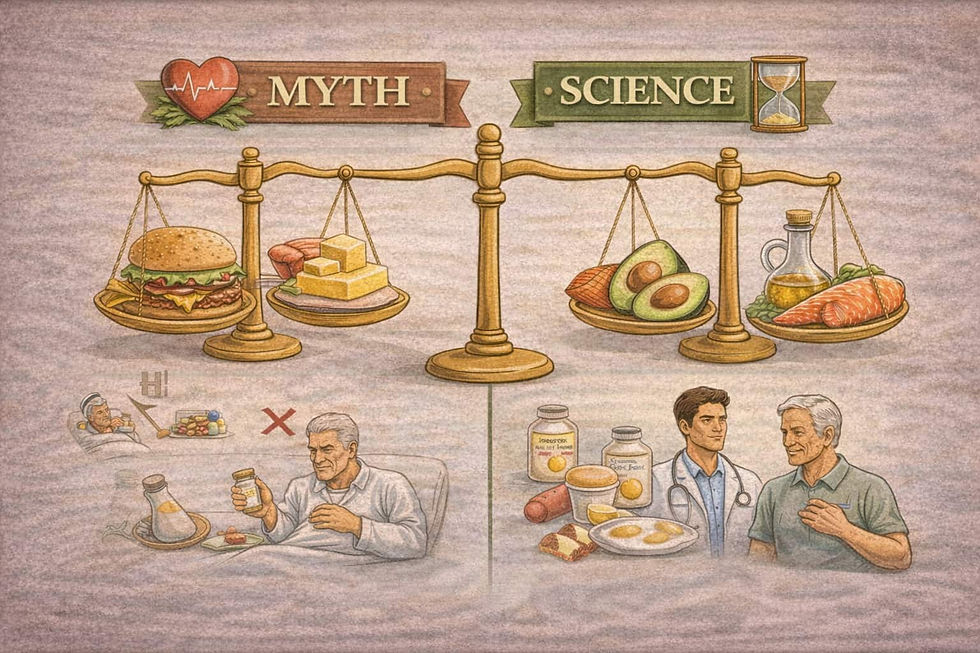
Introduction
Few topics in modern health science are as widely discussed—and misunderstood—as cholesterol. For decades, it has been labeled both a silent killer and an essential life-sustaining molecule. Conflicting advice from media, diet trends, and even medical discussions has left many people asking:
Is cholesterol harmful or necessary?
Should everyone aim for very low levels?
Can low cholesterol actually be dangerous in some cases?
In today’s world of plant-based diets, ketogenic lifestyles, statin therapies, and Blue Zone longevity research, cholesterol sits at the center of a complex health debate.
This comprehensive, evidence-based guide explores:
The true biological role of cholesterol
Its relationship with heart disease
How it affects lifespan across age groups
What modern research really says about optimal levels
1️⃣ What Is Cholesterol — and Why Do We Need It?

Cholesterol is a fat-like, waxy substance that is absolutely essential for human survival. Contrary to popular belief, it is not inherently harmful.
Where does cholesterol come from?
70–80% is produced by the liver
Remaining comes from dietary sources
Critical roles of cholesterol in the body
Cholesterol is indispensable for:
Cell membrane integrity – Provides structure and fluidity
Hormone production – Including testosterone, estrogen, and cortisol
Vitamin D synthesis – Essential for immunity and bone health
Bile acid formation – Required for fat digestion
Brain function – Supports myelin sheath and neural signaling
👉 Without cholesterol, life cannot exist.The issue is not cholesterol itself—but how it behaves in the body.
2️⃣ LDL vs HDL – Beyond “Good” and “Bad”

Cholesterol travels through the bloodstream via lipoproteins:
LDL (Low-Density Lipoprotein)
Transports cholesterol from liver to tissues
Excess levels may deposit in arterial walls
Often labeled “bad cholesterol”
HDL (High-Density Lipoprotein)
Removes excess cholesterol from bloodstream
Transports it back to the liver
Known as “good cholesterol”
Modern scientific perspective
The simple “good vs bad” classification is outdated. Current research highlights:
Particle size and number (ApoB)
Oxidation of LDL particles
Chronic inflammation levels
Insulin resistance and metabolic health
👉 Two people with identical LDL levels can have very different cardiovascular risks.
3️⃣ The Cholesterol–Heart Disease Connection

High LDL cholesterol has long been associated with:
Atherosclerosis
Coronary artery disease
Stroke
Heart attack
How plaque forms
LDL enters damaged arterial walls
It becomes oxidized
Immune system responds
Plaque builds up
Arteries narrow or rupture
Large-scale studies confirm:
✔ Lowering LDL reduces cardiovascular events
✔ Particularly beneficial in middle-aged and high-risk individuals
However, the relationship becomes less straightforward with aging.
4️⃣ Myth vs Science

Myth 1: “Cholesterol Causes All Heart Disease”
Reality:Cholesterol is only one piece of the puzzle.
Major contributors include:
Chronic inflammation
Smoking
Diabetes
High blood pressure
Obesity
Sedentary lifestyle
Insulin resistance
👉 Cholesterol increases risk—but rarely acts alone.
Myth 2: “Lower Cholesterol Always Means Longer Life”
Middle-aged adults:
Lower LDL → Lower cardiovascular risk
Elderly populations:
Very low cholesterol sometimes linked with higher mortality
⚠ Important clarification:
This does NOT mean high cholesterol is beneficial
Often reflects:
Chronic illness
Malnutrition
Frailty
Reverse causation
👉 Context is critical.
Myth 3: “Statins Reduce Lifespan”
Scientific evidence shows:
Reduced heart attack risk
Lower stroke incidence
Improved survival in high-risk groups
However, in older adults:
Benefits depend on overall health
Must be individualized
👉 One-size-fits-all conclusions are misleading.
Myth 4: “Dietary Cholesterol Is Dangerous”
Modern findings reveal:
Dietary cholesterol has minimal impact for most people
Eggs are generally safe in healthy individuals
Saturated fat and metabolic health matter more
Exceptions:
Diabetes
Genetic hypercholesterolemia
Myth 5: “High HDL Guarantees Protection”
Recent research shows:
Very high HDL ≠ automatic protection
Artificially raising HDL does not reduce risk
HDL function > HDL number
5️⃣ Cholesterol and Longevity: Age Matters

Ages 40–65
Strong correlation:
Higher LDL → Higher cardiovascular mortality
Lower LDL improves outcomes
Ages 70+
Relationship becomes complex:
Weaker LDL-mortality link
Sometimes inverse association in frail individuals
But:
Cardiovascular disease remains a leading cause of death
👉 Cholesterol impact varies with:
Age
Inflammation
Nutritional status
Overall resilience
6️⃣ The Real Longevity Drivers

Studies of long-lived populations show longevity depends more on:
Whole-food diets
Low chronic inflammation
Regular physical activity
Strong social relationships
Low stress levels
Stable metabolic health
👉 Cholesterol is just one marker—not the master variable.
7️⃣ Inflammation: The Missing Link

Modern cardiology emphasizes:
hs-CRP (inflammation marker)
Insulin resistance
Triglyceride/HDL ratio
Visceral fat
Blood pressure
Key insight
A person with:
Slightly high LDL
Low inflammation
Active lifestyle
May be healthier than someone with:
“Normal” LDL
High inflammation
Diabetes
Obesity
👉 Inflammation drives disease progression more than cholesterol alone.
8️⃣ Cholesterol and Brain Health

Extremely low cholesterol levels may be associated with:
Hemorrhagic stroke risk
Depression (in some studies)
Cognitive decline in frail elderly
On the other hand:
High vascular cholesterol → Increased risk of vascular dementia
👉 Balance—not extremes—is crucial.
9️⃣ Optimal Cholesterol for Longevity

There is no universal perfect number, but general guidance:
Middle-aged adults
LDL: Lower is generally better (especially high risk)
Triglycerides: Low
HDL: Moderate to high
Inflammation: Minimal
Older adults
Avoid extremes
Focus on:
Nutrition
Muscle mass
Functional health
👉 Personalized medicine is essential.
🔟 Practical Longevity Strategy

Instead of focusing only on cholesterol numbers:
Prioritize:
Reducing inflammation
Improving insulin sensitivity
Maintaining muscle mass
Eating whole, unprocessed foods
Regular physical activity
Stress management
Healthy body weight
👉 Cholesterol management should support overall health—not dominate it.
Conclusion

Cholesterol has long been misunderstood—often reduced to a single number on a lab report or labeled simply as “good” or “bad.” However, modern science paints a far more nuanced and insightful picture. Cholesterol is not an enemy to be eliminated, nor is it harmless enough to ignore. It is a biologically essential molecule that becomes harmful only under specific conditions shaped by lifestyle, metabolism, and systemic health.
The evidence is clear:
Elevated LDL cholesterol is strongly associated with increased cardiovascular risk, particularly in middle-aged individuals.
Lowering LDL through lifestyle or medication significantly reduces heart attacks and strokes in high-risk populations.
Yet, in older adults, the relationship between cholesterol and mortality becomes more complex, requiring individualized interpretation rather than rigid targets.
What truly determines longevity is not cholesterol alone—but the internal environment in which it operates.
Chronic inflammation, insulin resistance, oxidative stress, and metabolic dysfunction are the real drivers that transform cholesterol from a useful molecule into a harmful one. This is why two individuals with the same cholesterol levels can have vastly different health outcomes.
At the same time, extremely low cholesterol levels—especially in vulnerable or elderly individuals—may signal underlying issues such as malnutrition, chronic illness, or physiological decline. This reinforces a critical principle in modern medicine:👉 Health is not about extremes—it is about balance.
Longevity research consistently highlights that people who live the longest do not necessarily have the lowest cholesterol—they have the most stable and resilient biology.
Their lives are characterized by:
Nutrient-rich, whole-food diets
Regular physical activity
Strong social bonds
Low chronic stress
Healthy metabolic function
In this context, cholesterol becomes just one piece of a much larger puzzle.
The future of health is moving toward personalized medicine, where cholesterol levels are interpreted alongside inflammation markers, metabolic indicators, lifestyle factors, and individual risk profiles. This approach replaces outdated one-size-fits-all recommendations with more precise, meaningful strategies.
Final Takeaway
Cholesterol management should not be driven by fear—but by understanding.
It is not about aggressively chasing the lowest possible number.It is about maintaining a harmonious internal balance where cholesterol can perform its essential functions without contributing to disease.
👉 True longevity is achieved not by eliminating cholesterol, but by creating a body where it can exist safely—supported by healthy habits, metabolic stability, and informed medical guidance.
In the end, longevity is not a number—it is a state of balance, resilience, and intelligent living.
📢 Call to Action (CTA)
Your health is not defined by a single number—especially not cholesterol alone.
If you’re serious about improving longevity, don’t just chase lab reports. Focus on building a metabolically strong, inflammation-resistant body through daily habits that truly matter.
👉 Start today:
Get a complete lipid profile (including ApoB if possible)
Track your inflammation markers (hs-CRP)
Prioritize whole foods over processed diets
Move your body every single day
Build and maintain lean muscle mass
Manage stress as seriously as you manage diet
💡 Most importantly—don’t self-prescribe treatments.Work with a qualified healthcare professional to create a plan tailored to your age, risk profile, and long-term goals.
Longevity is not about eliminating cholesterol—it’s about mastering balance.
Frequently Asked Questions
1. Is total cholesterol important?
Less important than LDL, HDL, triglycerides, and inflammation markers.
2. Should everyone take statins?
No. Only individuals with significant cardiovascular risk benefit clearly.
3. Are eggs harmful?
Generally safe for healthy individuals when consumed in moderation.
4. Does cholesterol increase with age?
Yes, especially LDL, due to hormonal and metabolic changes.
5. Can low cholesterol cause depression?
Some associations exist, but causation is not fully established.
6. Are plant-based diets beneficial?
Often reduce LDL and inflammation, improving overall health.
7. Does exercise lower cholesterol?
Improves HDL and metabolic health; modest LDL reduction.
8. Should cholesterol be monitored after 70?
Depends on overall health and clinical context.
9. What matters more: LDL or particle size?
Particle number (ApoB) may be more predictive.
10. What matters most for longevity?
Metabolic health, inflammation control, muscle mass, and lifestyle consistency.
📚 References
Brian A. Ference, B. A., Ginsberg, H. N., Graham, I., Ray, K. K., Packard, C. J., Bruckert, E., … Catapano, A. L. (2017). Low-density lipoproteins cause atherosclerotic cardiovascular disease. European Heart Journal, 38(32), 2459–2472. https://doi.org/10.1093/eurheartj/ehx144
Cholesterol Treatment Trialists’ Collaboration. (2010). Efficacy and safety of more intensive lowering of LDL cholesterol: A meta-analysis. The Lancet, 376(9753), 1670–1681. https://doi.org/10.1016/S0140-6736(10)61350-5
Scott M. Grundy, S. M., Stone, N. J., Bailey, A. L., Beam, C., Birtcher, K. K., Blumenthal, R. S., … Yeboah, J. (2019). 2018 AHA/ACC cholesterol clinical practice guideline. Circulation, 139(25), e1082–e1143. https://doi.org/10.1161/CIR.0000000000000625
Paul M. Ridker, P. M., Danielson, E., Fonseca, F. A. H., Genest, J., Gotto, A. M., Kastelein, J. J. P., … Glynn, R. J. (2008). C-reactive protein and cardiovascular risk. New England Journal of Medicine, 359, 2195–2207. https://doi.org/10.1056/NEJMoa0807646
Benjamin F. Voight, B. F., Peloso, G. M., Orho-Melander, M., Frikke-Schmidt, R., Barbalic, M., Jensen, M. K., … Kathiresan, S. (2012). Plasma HDL cholesterol and risk of myocardial infarction. The Lancet, 380(9841), 572–580. https://doi.org/10.1016/S0140-6736(12)60312-2
Patty W. Siri-Tarino, P. W., Sun, Q., Hu, F. B., & Krauss, R. M. (2010). Meta-analysis of saturated fat and cardiovascular disease. American Journal of Clinical Nutrition, 91(3), 535–546. https://doi.org/10.3945/ajcn.2009.27725
Ariela R. Orkaby, A. R., Driver, J. A., Ho, Y. L., Lu, B., Costa, L., Honerlaw, J., … Gaziano, J. M. (2020). Statin use and mortality in older adults. JAMA, 324(1), 68–78. https://doi.org/10.1001/jama.2020.7848
Uffe Ravnskov, U., Diamond, D. M., Hama, R., Hamazaki, T., Hammarskjöld, B., Hynes, N., … Okuyama, H. (2016). LDL cholesterol and mortality in elderly. BMJ Open, 6(6), e010401. https://doi.org/10.1136/bmjopen-2015-010401
John T. Wilkins, J. T., Ning, H., Stone, N. J., Criqui, M. H., Zhao, L., Lloyd-Jones, D. M. (2014). Lifetime risk and cholesterol levels. Journal of the American College of Cardiology, 64(15), 1520–1529. https://doi.org/10.1016/j.jacc.2014.06.1188
Archana Singh-Manoux, A., Gimeno, D., Kivimäki, M., Brunner, E. J., & Marmot, M. G. (2018). Cholesterol and cognitive decline. European Heart Journal, 39(36), 3453–3461. https://doi.org/10.1093/eurheartj/ehy348
Peter Libby. (2021). The changing landscape of atherosclerosis. Nature, 592, 524–533. https://doi.org/10.1038/s41586-021-03392-8
Marc S. Sabatine, M. S., Giugliano, R. P., Keech, A. C., Honarpour, N., Wiviott, S. D., Murphy, S. A., … Pedersen, T. R. (2017). Evolocumab and clinical outcomes. New England Journal of Medicine, 376, 1713–1722. https://doi.org/10.1056/NEJMoa1615664
Michael G. Silverman, M. G., Ference, B. A., Im, K., Wiviott, S. D., Giugliano, R. P., Grundy, S. M., … Sabatine, M. S. (2016). LDL reduction and cardiovascular risk. JAMA, 316(12), 1289–1297. https://doi.org/10.1001/jama.2016.13985
Samia Mora, S., Otvos, J. D., Rosenson, R. S., Pradhan, A., Buring, J. E., & Ridker, P. M. (2010). Lipoprotein particle size and risk. Circulation, 121(21), 2383–2392. https://doi.org/10.1161/CIRCULATIONAHA.109.873885
Jennifer G. Robinson, J. G., Wang, S., Smith, B. J., & Jacobson, T. A. (2015). LDL reduction and outcomes. JAMA, 313(10), 1026–1035. https://doi.org/10.1001/jama.2015.0613
Louise Bowman, L., Mafham, M., Wallendszus, K., Stevens, W., Buck, G., Barton, J., … Collins, R. (2016). Effects of statin therapy. The Lancet, 388(10059), 2532–2561. https://doi.org/10.1016/S0140-6736(16)31357-5
Børge G. Nordestgaard, B. G., Benn, M., Schnohr, P., & Tybjærg-Hansen, A. (2007). Triglycerides and cardiovascular risk. JAMA, 298(3), 299–308. https://doi.org/10.1001/jama.298.3.299
Emerging Risk Factors Collaboration. (2009). Major lipids and vascular risk. The Lancet, 373(9671), 117–125. https://doi.org/10.1016/S0140-6736(08)61898-7
Massimo F. Piepoli, M. F., Hoes, A. W., Agewall, S., Albus, C., Brotons, C., Catapano, A. L., … Tiberi, M. (2016). European cardiovascular prevention guidelines. European Heart Journal, 37(29), 2315–2381. https://doi.org/10.1093/eurheartj/ehw106
Salim Yusuf, S., Hawken, S., Ôunpuu, S., Dans, T., Avezum, A., Lanas, F., … INTERHEART Study Investigators. (2004). Modifiable risk factors and cardiovascular disease. The Lancet, 364(9438), 937–952. https://doi.org/10.1016/S0140-6736(04)17018-9


Comments