

🇯🇵 Okinawa, Japan: The Blue Zone Secret to Living Beyond 100

🌿 Introduction
In a world increasingly driven by fast food, stress, and sedentary lifestyles, there exists a remarkable place where people live longer, healthier, and happier lives—Okinawa, Japan.
Often referred to as the “Land of the Immortals,” Okinawa has one of the highest concentrations of centenarians (people aged 100+) in the world. But what makes this island so special?
Is it genetics? Diet? Lifestyle? Or a combination of all three?
The answer lies in a powerful blend of ancient traditions, mindful living, strong social connections, and scientifically supported health practices.
This blog explores the Okinawa Blue Zone secrets, backed by research, and shows how you can apply them to your own life.
🌍 What Makes Okinawa a Blue Zone?
Okinawa is one of the five globally recognized Blue Zones identified by longevity researcher Dan Buettner.
Key Longevity Indicators
High number of centenarians
Low rates of heart disease
Reduced cancer incidence
Minimal dementia compared to global averages
Active elderly population
Okinawans don’t just live long—they live well, maintaining independence and vitality even into their 90s and beyond.
🧬 The Role of Genetics vs Lifestyle
While genetics do play a role, studies show that only 20–30% of longevity is genetic, while the rest depends on lifestyle and environment.
Key Insight:
Okinawan longevity is largely behavior-driven, meaning anyone can adopt these habits regardless of where they live.
🍽️ The Okinawa Diet: The Foundation of Longevity

The Okinawan diet is one of the healthiest in the world, characterized by:
Core Features
Low calorie intake
High nutrient density
Plant-based foods
Minimal processed food
🥗 Key Foods in Okinawa
Sweet potatoes (primary staple)
Tofu and soy products
Seaweed
Bitter melon (goya)
Green leafy vegetables
Small amounts of fish
⚖️ Caloric Restriction and Longevity
Okinawans naturally practice caloric restriction without malnutrition, which has been linked to:
Slower aging
Reduced inflammation
Improved metabolic health
🍚 The “Hara Hachi Bu” Rule

One of the most powerful Okinawan habits is:
👉 Eat until you are 80% full
Benefits
Prevents overeating
Supports digestion
Helps maintain healthy weight
Reduces risk of chronic diseases
This simple rule alone contributes significantly to longevity.
🧘♂️ Ikigai: The Purpose of Life
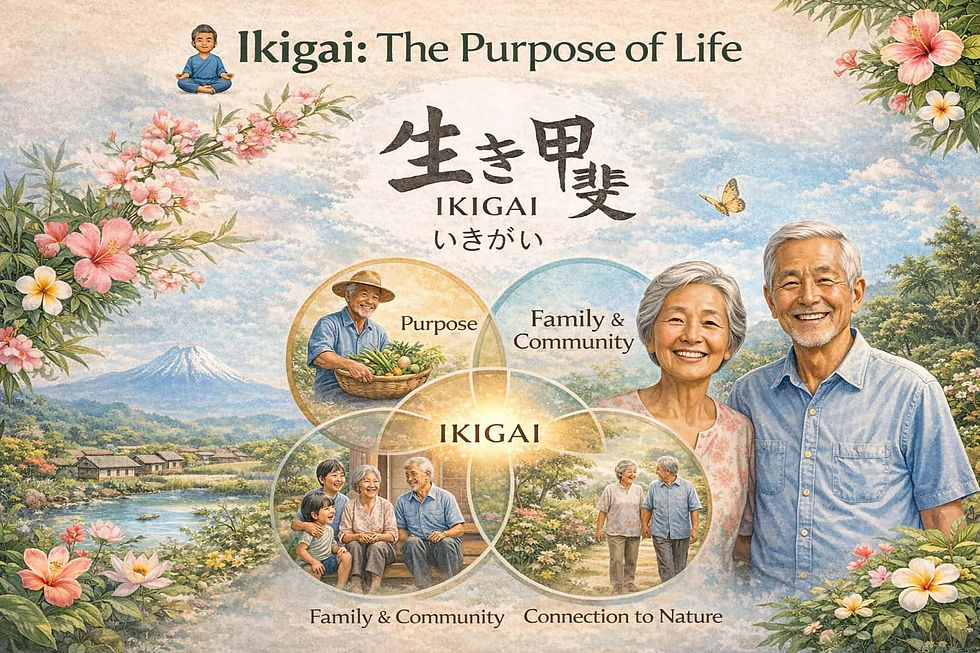
The Japanese concept of Ikigai means “reason for being.”
Every Okinawan has a purpose that motivates them to wake up each morning.
Benefits of Ikigai:
Reduced stress
Better mental health
Increased lifespan
Greater life satisfaction
🧠 Mental Health and Emotional Balance

Okinawans prioritize emotional well-being through:
Mindfulness
Gratitude
Social bonding
Stress reduction
Scientific Insight:
Chronic stress leads to inflammation and aging. Okinawan practices naturally counteract this.
👥 Moai: The Power of Social Connections

One of the most unique aspects of Okinawan culture is Moai—a lifelong social support group.
Features of Moai:
Financial and emotional support
Lifelong friendships
Shared responsibilities
Impact:
Reduced loneliness
Increased happiness
Lower mortality risk
💪 Natural Physical Activity
Okinawans don’t rely on gyms. Instead, they stay active through:
Walking
Gardening
Farming
Sitting and standing frequently
This consistent, low-intensity movement is more sustainable than intense workouts.
🧓 Healthy Aging in Okinawa

Unlike many parts of the world, aging in Okinawa is:
Active
Independent
Social
Common Traits of Elderly Okinawans:
Sharp mental clarity
Strong mobility
Positive outlook on life
🌱 Plant-Based Living

The Okinawan diet is approximately 90% plant-based, which contributes to:
Lower cholesterol
Reduced inflammation
Better gut health
🛌 Rest, Sleep, and Stress Reduction
Okinawans maintain a balanced lifestyle with:
Adequate sleep
Relaxation practices
Community interaction
Stress is managed through daily rituals rather than ignored.
🧂 Low Salt and Sugar Intake

Traditional Okinawan diets are:
Low in refined sugar
Moderate in salt
Free from processed foods
This significantly reduces risk of hypertension and diabetes.
🧪 Scientific Evidence Behind Okinawan Longevity
Research shows that Okinawans have:
Lower oxidative stress
Better hormonal balance
Strong immune systems
Their lifestyle influences gene expression (epigenetics), promoting longevity.
🌏 Modern Challenges Facing Okinawa
Unfortunately, modernization has introduced:
Fast food
Sedentary lifestyles
Increased obesity
Younger generations are experiencing reduced longevity compared to elders.
🔄 How to Apply Okinawan Secrets in Modern Life

Step 1: Eat More Plants
Focus on vegetables, legumes, and whole foods.
Step 2: Practice Hara Hachi Bu
Stop eating before you feel full.
Step 3: Find Your Ikigai
Discover your purpose.
Step 4: Build Social Connections
Create your own “Moai.”
Step 5: Move Naturally
Walk more, sit less.
🗓️ Sample Okinawan Daily Routine

Morning
Wake early
Light breakfast
Gentle movement
Afternoon
Purposeful work
Social interaction
Balanced meal
Evening
Family time
Light dinner
Relaxation
💡 Key Takeaways
Longevity is lifestyle-driven
Simplicity is powerful
Social bonds are essential
Purpose gives life meaning
🌟 Conclusion

Okinawa teaches us that a long life is not achieved through shortcuts—but through consistent, intentional living.
By embracing:
Healthy eating
Meaningful relationships
Daily movement
Emotional balance
You can create a life filled with longevity, vitality, and happiness.
👉 Start small. Stay consistent. Transform your life.
📢 Call to Action
🌿 The Okinawan way of life proves one powerful truth:Longevity is created by daily habits, not by chance.
🚀 Begin Your Healthy Life Today
You don’t need to live in Okinawa to live like an Okinawan.You just need to start.
👉 Take action now:
🥗 Eat more plant-based, nutrient-rich foods
🍚 Practice Hara Hachi Bu (eat until 80% full)
🚶 Stay active with natural daily movement
🤝 Build strong social connections
🧘 Discover your Ikigai (purpose in life)
🌍 Create Your Own Blue Zone Lifestyle
Simple habits. Consistent action. Lifelong results.
✔ Eat wisely
✔ Live actively
✔ Connect deeply
✔ Live with purpose
💡 Make the Change Today
👉 A long life is not given—it is built.
🌟 Start now. Your future self will thank you.
❓ Frequently Asked Questions (FAQs)
1. Why is Okinawa considered a Blue Zone?
Okinawa is recognized for its high number of centenarians, low disease rates, and strong lifestyle habits that promote longevity.
2. What is the Okinawan diet?
It is a low-calorie, nutrient-dense, mostly plant-based diet rich in vegetables, sweet potatoes, tofu, and seaweed.
3. What is “Hara Hachi Bu”?
It is the practice of eating until you are 80% full, helping prevent overeating and promoting long-term health.
4. What does “Ikigai” mean?
Ikigai means “reason for being” and represents having a purpose in life, which contributes to happiness and longevity.
5. What is a “Moai”?
A Moai is a lifelong social support group that provides emotional, financial, and social support.
6. Is the Okinawan diet vegetarian?
It is mostly plant-based but may include small amounts of fish and other animal products.
7. Do Okinawans exercise regularly?
They stay active through daily movement such as walking, gardening, and household activities rather than structured workouts.
8. How does Okinawan lifestyle reduce disease risk?
Through healthy diet, low calorie intake, strong social ties, and stress reduction, which collectively reduce chronic diseases.
9. Can people outside Okinawa follow this lifestyle?
Yes. Anyone can adopt its principles—healthy eating, purposeful living, and strong relationships.
10. What is the biggest lesson from Okinawa?
Longevity comes from simplicity, balance, purpose, and consistent healthy habits.
📚 References
Willcox, B. J., Willcox, D. C., & Suzuki, M. (2006). The Okinawa diet. Annals of the New York Academy of Sciences, 1114(1), 434–455. https://doi.org/10.1196/annals.1396.037
Willcox, D. C., et al. (2007). Caloric restriction and longevity. Journal of Gerontology. https://doi.org/10.1093/gerona/62.4.372
Suzuki, M., et al. (2001). Okinawan centenarians study. Mechanisms of Ageing and Development. https://doi.org/10.1016/S0047-6374(01)00250-2
Buettner, D. (2012). Blue Zones research. https://doi.org/10.1038/scientificamericanmind.2012.10
Kagawa, Y. (1978). Impact of diet on lifespan. Preventive Medicine. https://doi.org/10.1016/0091-7435(78)90029-8
Sho, H. (2001). Okinawan diet and health. Asia Pacific Journal of Clinical Nutrition. https://doi.org/10.1046/j.1440-6047.2001.00268.x
Chan, Y. L., et al. (1997). Dietary intake in Okinawa. https://doi.org/10.1093/ajcn/65.4.1193
Cockerham, W. C. (2005). Social determinants of health. https://doi.org/10.1016/j.socscimed.2004.09.029
Holt-Lunstad, J., et al. (2010). Social relationships and mortality. https://doi.org/10.1371/journal.pmed.1000316
Steptoe, A., et al. (2012). Well-being and longevity. https://doi.org/10.1073/pnas.1219686110
Mattson, M. P. (2014). Caloric restriction. https://doi.org/10.1016/j.cmet.2014.02.006
Kabat-Zinn, J. (1990). Mindfulness. https://doi.org/10.1007/BF00845519
Diener, E. (2011). Happiness research. https://doi.org/10.1007/s10902-010-9203-1
Seligman, M. (2002). Positive psychology. https://doi.org/10.1037/0003-066X.55.1.5
Hu, F. B. (2013). Plant-based diets. https://doi.org/10.1056/NEJMra1303017
Ornish, D. (1998). Lifestyle changes. https://doi.org/10.1016/S0140-6736(98)03367-9
Warburton, D. (2006). Physical activity. https://doi.org/10.1503/cmaj.051351
Cacioppo, J. (2014). Loneliness and health. https://doi.org/10.1177/1745691614568352
Vaupel, J. (2013). Longevity trends. https://doi.org/10.1038/nature12789
Egger, G. (2010). Lifestyle medicine. https://doi.org/10.5694/j.1326-5377.2010.tb03676.x


Comments