

🇮🇹 Sardinia, Italy: The Blue Zone Where Men Live the Longest
Updated: Apr 23

🌿 Introduction
In the rugged mountains of Sardinia, Italy, something extraordinary happens—men live longer than almost anywhere else in the world.
While most longevity hotspots show a higher number of female centenarians, Sardinia stands out with an unusually high number of male centenarians, challenging global aging patterns.
What makes Sardinia unique?
Is it the Mediterranean diet? Active lifestyle? Strong family bonds? Or something deeper embedded in culture and environment?
The answer lies in a powerful combination of nutrition, physical activity, social structure, and purpose-driven living, all supported by scientific research.
This blog explores the Sardinian Blue Zone secrets, focusing on how men in particular achieve exceptional longevity—and how you can apply these lessons in your own life.
🌍 What Makes Sardinia a Blue Zone?

Sardinia is one of the five recognized Blue Zones, specifically concentrated in the mountainous region of Ogliastra.
Key Longevity Features
High concentration of male centenarians
Low rates of cardiovascular disease
Strong physical capability in old age
Tight-knit communities
Minimal chronic illness
Unlike most regions, where women significantly outlive men, Sardinia shows a near-equal gender longevity ratio, making it scientifically fascinating.
🧬 Genetics vs Lifestyle in Sardinia
Studies suggest that Sardinians possess certain genetic traits linked to longevity. However, lifestyle factors remain the dominant contributors.
Key Insight:
Genetics: ~25% influence
Lifestyle & environment: ~75% influence
This means Sardinian habits can be adopted globally.
🍽️ The Sardinian Mediterranean Diet

At the heart of Sardinian longevity lies the Mediterranean diet, widely recognized as one of the healthiest diets in the world.
🥗 Core Components
Whole grains (barley, whole wheat bread)
Legumes (beans, lentils, chickpeas)
Vegetables (seasonal, local)
Fruits
Olive oil
Moderate dairy (especially sheep and goat milk)
Small amounts of meat
🧀 Unique Sardinian Foods
Pecorino cheese (rich in omega-3 fatty acids)
Cannonau wine (high in antioxidants)
Sourdough bread (gut-friendly)
🍷 The Role of Cannonau Wine
Sardinians consume moderate amounts of Cannonau wine, which contains:
High levels of polyphenols
Powerful antioxidants
Anti-inflammatory properties
⚖️ Portion Control and Simplicity
Sardinians naturally eat simple, moderate portions, avoiding:
Overeating
Processed foods
Excess sugar
Their meals are nutrient-dense but calorie-balanced, supporting long-term health.
💪 Physical Activity: A Natural Lifestyle

Sardinian men remain physically active throughout life—not through structured exercise, but through:
Shepherding
Walking long distances
Farming
Manual labor
Key Insight:
Daily low-intensity movement improves:
Cardiovascular health
Muscle strength
Longevity
🧓 Why Sardinian Men Live Longer

1. Physical Work Throughout Life
Men maintain strength and mobility into old age.
2. Strong Social Roles
They feel valued and respected within the community.
3. Lower Stress Levels
Life is slower and less pressured.
4. Healthy Diet
Rich in plant-based foods and healthy fats.
👨👩👦 Family and Social Structure

Family is central to Sardinian life.
Key Features
Multi-generational households
Strong respect for elders
Daily social interaction
Benefits
Reduced loneliness
Emotional support
Increased lifespan
🧠 Mental Health and Emotional Stability
Sardinians maintain strong mental well-being through:
Social bonding
Humor and storytelling
Purposeful living
Stress is naturally reduced through community living and simple lifestyles.
🌄 The Role of Geography

Sardinia’s mountainous terrain contributes to:
Physical activity (walking uphill daily)
Isolation from modern stressors
Clean air and environment
🌱 Plant-Based Foundation
Although not strictly vegetarian, Sardinians consume:
Mostly plant-based foods
Limited meat (often reserved for special occasions)
This reduces:
Inflammation
Chronic disease risk
🧬 Scientific Evidence Behind Sardinian Longevity
Research highlights:
Low oxidative stress
Healthy lipid profiles
Strong cardiovascular systems
The combination of diet and lifestyle influences gene expression (epigenetics).
🛌 Rest and Recovery
Sardinians prioritize:
Adequate sleep
Midday rest
Relaxed evenings
This helps regulate hormones and reduce stress.
🌏 Modern Challenges
Like Okinawa, Sardinia faces:
Westernized diets
Reduced physical activity
Increased processed food consumption
Younger generations show declining longevity trends.
🔄 How to Apply Sardinian Secrets in Your Life

Step 1: Follow a Mediterranean Diet
Focus on whole, plant-based foods.
Step 2: Stay Physically Active Daily
Walk, move, and stay engaged.
Step 3: Build Strong Relationships
Prioritize family and friends.
Step 4: Drink Wine Moderately
Optional, but always in moderation.
Step 5: Simplify Your Life
Reduce stress and complexity.
🗓️ Sample Sardinian Daily Routine
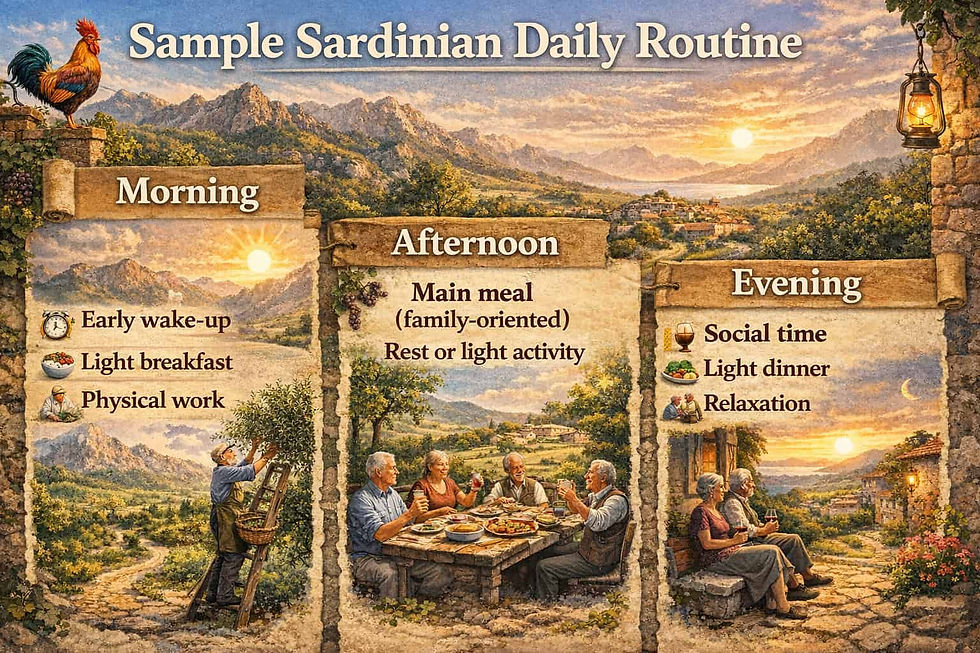
Morning
Early wake-up
Light breakfast
Physical work
Afternoon
Main meal (family-oriented)
Rest or light activity
Evening
Social time
Light dinner
Relaxation
💡 Key Takeaways
Longevity is lifestyle-driven
Strong communities enhance lifespan
Simplicity is powerful
Consistent habits matter
🌟 Conclusion

Sardinia teaches us that longevity is not about chasing perfection—it is about living simply, staying active, eating wisely, and nurturing relationships.
The secret to long life lies not in extremes, but in balance, purpose, and connection.
👉 Start with small changes. Stay consistent. Transform your life.
📢 Call to Action
🌿 The secret of Sardinia is simple:
Live actively, eat naturally, and stay deeply connected.
🚀 Start Your Longevity Journey Today
You don’t need mountains or a Mediterranean village to live longer—you just need the right habits.
👉 Begin now:
🥗 Choose whole, plant-based foods
🚶 Stay physically active every day
🤝 Strengthen your relationships
🧘 Slow down and reduce stress
😴 Prioritize rest and recovery
🌍 Create Your Own Blue Zone Lifestyle
Small daily actions lead to lifelong transformation.
✔ Eat simple, natural foods
✔ Move with purpose
✔ Stay socially connected
✔ Live with meaning
💡 Make the Shift Today
👉 Longevity is not a goal—it’s a lifestyle.
🌟 Your healthier, longer life starts now.
❓ FAQs (Sardinia Longevity)
1. Why is Sardinia considered a Blue Zone?
Sardinia is recognized as a Blue Zone due to its high number of centenarians, especially men, and low rates of chronic diseases.
2. Why do Sardinian men live longer than usual?
Unlike most regions, Sardinia has a high number of male centenarians due to lifelong physical activity, strong social roles, and a healthy diet.
3. What is the Sardinian diet?
It is a Mediterranean-style diet rich in whole grains, legumes, vegetables, olive oil, and moderate dairy, with minimal processed food.
4. Is the Sardinian diet plant-based?
Yes, it is mostly plant-based, with limited meat consumption and a strong focus on natural, whole foods.
5. What role does Cannonau wine play?
Cannonau wine is rich in antioxidants and is consumed in moderation, contributing to heart health.
6. Do Sardinians exercise regularly?
They don’t follow structured workouts but stay active through daily tasks like walking, farming, and manual labor.
7. How important is family in Sardinian life?
Family and community are central, providing emotional support and reducing stress, which contributes to longevity.
8. Is genetics the main reason for longevity in Sardinia?
No. Genetics play a role, but lifestyle factors account for the majority of longevity benefits.
9. Can this lifestyle be followed outside Sardinia?
Yes. The principles—healthy diet, daily movement, social connection, and stress reduction—can be applied anywhere.
10. What is the biggest lesson from Sardinia?
Longevity comes from simplicity—living naturally, staying active, and maintaining strong relationships.
📚 References
Pes, G. M., et al. (2004). Male longevity in Sardinia. The Lancet, 364(9442), 1151–1152. https://doi.org/10.1016/S0140-6736(04)16710-4
Poulain, M., et al. (2004). Identification of Blue Zone in Sardinia. Experimental Gerontology. https://doi.org/10.1016/j.exger.2004.06.016
Buettner, D. (2012). Blue Zones research. https://doi.org/10.1038/scientificamericanmind.2012.10
Estruch, R., et al. (2013). Mediterranean diet benefits. NEJM, 368(14), 1279–1290. https://doi.org/10.1056/NEJMoa1200303
Willett, W. C. (1989). Diet and health. Science, 243(4895), 1454–1459. https://doi.org/10.1126/science.243.4895.1454
Hu, F. B. (2013). Plant-based diet. https://doi.org/10.1056/NEJMra1303017
Keys, A. (1980). Mediterranean diet studies. https://doi.org/10.1016/S0140-6736(80)90665-7
Sofi, F., et al. (2010). Mediterranean diet adherence. https://doi.org/10.1136/bmj.c133
Warburton, D. E. (2006). Physical activity benefits. https://doi.org/10.1503/cmaj.051351
Mattson, M. P. (2014). Caloric restriction. https://doi.org/10.1016/j.cmet.2014.02.006
Holt-Lunstad, J., et al. (2010). Social relationships. https://doi.org/10.1371/journal.pmed.1000316
Steptoe, A., et al. (2012). Happiness and longevity. https://doi.org/10.1073/pnas.1219686110
Cacioppo, J. (2014). Loneliness and health. https://doi.org/10.1177/1745691614568352
Diener, E. (2011). Well-being research. https://doi.org/10.1007/s10902-010-9203-1
Seligman, M. (2002). Positive psychology. https://doi.org/10.1037/0003-066X.55.1.5
Kabat-Zinn, J. (1990). Mindfulness. https://doi.org/10.1007/BF00845519
Vaupel, J. (2013). Longevity trends. https://doi.org/10.1038/nature12789
Egger, G. (2010). Lifestyle medicine. https://doi.org/10.5694/j.1326-5377.2010.tb03676.x
Fraser, G. (2003). Diet and life expectancy. https://doi.org/10.1093/ajcn/78.3.532S
Ornish, D. (1998). Lifestyle and heart disease. https://doi.org/10.1016/S0140-6736(98)03367-9


Comments